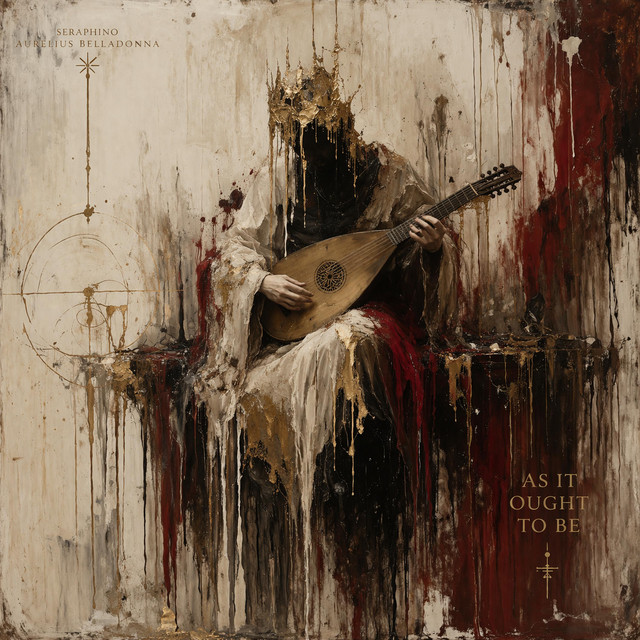
A song by Seraphino Aurelius Belladonna
When Constantinople Fell
A grave remembrance of a city’s last bells, broken walls, scattered books, and the afterlife of memory.
- From the album
- As It Ought to Be
- Album sequence
- Track 5 of 14
- First released
- Running time
- 4:57
The matter at hand
What the song concerns
Seraphino turns from satire to historical lament, placing the listener inside the final hours of Constantinople in 1453. Cannons, bells, walls, books, and fleeing scholars become fragments of a civilization crossing violently from lived reality into memory.
The song mourns more than conquest. It considers what survives when institutions fall: manuscripts carried westward, melodies remembered, knowledge displaced, and a city whose vanished sound continues to shape the world that followed.
In his own estimation
Seraphino, upon its composition
There are ruins one may admire at a comfortable distance, and there are losses whose dust still resteth upon the present. Constantinople was not merely stone taken by force. It was a treasury of voices, arguments, prayers, books, and inherited memory—an entire world hearing its final bells beneath the cannon.
I wrote without jest because the subject required none. Yet lament need not declare that all was extinguished. Scholars fled with texts beneath their arms; ideas crossed borders their guardians could not. The walls fell, but memory proved less obedient. Long after stone surrendereth, music continueth the siege.
“Long after the stones are gone, their music haunts the heart.”
The complete text
Lyrics
The bells were drowned by thunder,
By fire against the wall.
The sacred stones of emperors
Began at last to fall.
The painted saints looked downward
Through smoke and bitter rain,
Whilst every shattered chapel door
Cried out in iron pain.
The scholars clasped their precious books
Like mothers clutching sons.
The harbor burned beneath the dawn,
Red brighter than the sun.
The priests still sang in trembling halls
Though death stood at the gate,
And somewhere deep in marble courts
The old world learned its fate.
Oh, Constantinople—
Queen of fading light.
The candles of the eastern world
Were swallowed by the night.
And all the gold of emperors,
All banners, crowns, and fame,
Could not command the dying stars
To turn their course again.
The cannons spoke like devils
Across the trembling sea.
The walls that stood a thousand years
Bent slowly to their knees.
The market squares fell silent,
The palace fires climbed high,
And every choir still singing there
Prepared itself to die.
Some fled into the darkness,
Some vanished where they prayed.
Some swore the angels left the earth
The moment breach was made.
And though the world kept turning
As all worlds cruelly do,
Something old and beautiful
Departed with the blue.
Oh, Constantinople—
Queen of fading light.
The candles of the eastern world
Were swallowed by the night.
And all the gold of emperors,
All banners, crowns, and fame,
Could not command the dying stars
To turn their course again.
Now lesser men speak proudly
Of triumph, trade, and war,
As though the fall of greatness
Were a thing to hunger for.
But I have heard cathedral bells
Still echo through the years,
Like ghosts beneath the drowning waves
That toll for vanished spheres.
Oh, Constantinople—
Though marble turns to dust,
The memory of thy final dawn
Still lingers in the rust.
For kingdoms die by sword and flame,
And towers break apart—
Yet long after the stones are gone,
Their music haunts the heart.
Further evidence